1. Executive Sourcing Guide: Procurement Dynamics of CE Certified Veterinary Spay Kits
In the global veterinary healthcare sector, small animal ovariohysterectomy (spaying) and orchiectomy (neutering) remain the most frequently performed soft-tissue surgical procedures. As veterinary clinical standards align more closely with human surgical protocols, international procurement managers, hospital networks, and medical device distributors face mounting pressure to source high-grade, reusable surgical instrument kits that comply with rigorous international regulatory frameworks, such as the European CE Mark (EU MDR 2017/745 alignment) and ISO 13485 / ISO 9001:2015 quality management standards.
Selecting premier CE Certified Veterinary Spay Kit Factories & Exporters requires evaluating far more than initial unit prices. High-volume spay and neuter clinics demand surgical sets that retain mechanical alignment, cutting sharpness, and structural integrity across hundreds of automated high-temperature autoclave cycles. Subpar instruments made from inferior non-martensitic steel grades often suffer from micro-pitting, stress corrosion cracking, jaw misalignment, and premature ratchet failure—leading to surgical complications such as pedicle slippage or tissue trauma during vascular ligation.
2. Industrial Heritage & Metallurgical Engineering Excellence
Rooted in the historic manufacturing cluster of Sialkot, Pakistan—a region internationally recognized for supplying over 70% of the world's precision hand-held surgical tools—our manufacturing ecosystem has synthesized generational hand-craftsmanship with state-of-the-art European CNC engineering since 1995. Operating under an ISO 9001:2015 certified Quality Management System, our facilities supply hospital-grade surgical, dental, orthopedic, and specialized veterinary instruments to procurement partners across more than 60 countries, including the United States, Germany, the United Kingdom, Japan, and the United Arab Emirates.
Martensitic Stainless Steels
We exclusively utilize high-grade AISI 410, AISI 420, and AISI 440A surgical-grade martensitic alloys. High carbon content delivers optimal Rockwell Hardness (50-56 HRC for cutting edges), while elevated chromium content ensures maximum oxidation resistance.
Computerized Heat Treatment
Instruments undergo vacuum furnace hardening followed by precise secondary tempering stages. This eliminates internal molecular stresses, guaranteeing that needle holders and hemostats retain spring tension without brittle fractures under torque.
Automated Passivation
Every batch undergoes nitric or citric acid chemical passivation to remove surface iron residues. This process accelerates the formation of a continuous passive passive oxide film (Cr₂O₃) conforming to ASTM F1089 boiling test standards.
3. Anatomical Engineering of a CE Certified Veterinary Spay Kit
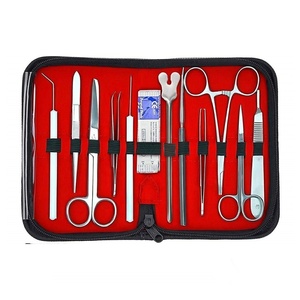
A standardized veterinary ovariohysterectomy kit must provide complete anatomical versatility for feline, canine, and exotic patient sizes. Each tool within the pack serves a dedicated surgical function, requiring specific tip geometry, ratchet tension, and ergonomic feedback.
| Instrument Name | Standard Sizes | Material Specification | Key Engineering Feature | Clinical Application |
|---|---|---|---|---|
| Snook Ovariotomy Hook | 7" (18 cm) / 8" (20 cm) | AISI 420 Stainless Steel | Blunt, button-tipped curved end with smooth satin finish | Blind elevation of the uterine horn and ovarian ligament through mini-laparotomy incisions. |
| Olsen-Hegar Needle Holder | 5.5", 6.5", 7.5" | AISI 420 + Tungsten Carbide (TC) | Combined scissor-needle driver with gold-plated handles & cross-hatched TC jaw inserts | Rapid ligation and suturing without swapping instruments, increasing operative efficiency. |
| Rochester-Carmalt Forceps | 6.25" / 8" (Straight & Curved) | AISI 410 / 420 Stainless Steel | Longitudinal serrations with cross-hatched tips | Hemostasis of broad uterine vascular pedicles, preventing tissue slippage during ligation. |
| Kelly / Crile Hemostatic Forceps | 5.5" (14 cm) Straight/Curved | AISI 410 Stainless Steel | Transverse serrations (partial or full length); precision box-lock | Clamping small-to-medium blood vessels in subcutaneous tissue layers. |
| Mayo & Metzenbaum Scissors | 5.5" to 7" Straight & Curved | AISI 440A High-Hardness Steel | Micro-serrated edge or SuperCut razor-ground blade design | Mayo for tough fascial transection; Metzenbaum for delicate visceral tissue dissection. |
| Backhaus Towel Clamps | 3.5" / 5.5" | AISI 410 Stainless Steel | Sharp perforating tips with positive ratchet locking mechanism | Securing surgical drapes to the patient’s skin without slipping during abdominal procedures. |
4. Future Procurement Trends in the Veterinary Surgical Industry (2025–2030)
As global veterinary practice management consolidates into large corporate groups and hospital networks, the procurement criteria for surgical instruments are undergoing a structural shift. Buying decisions are moving from transactional per-unit acquisitions to holistic lifecycle cost modeling.
Trend 1: Micro-Laparoscopic & Minimally Invasive Spay Kits
Laparoscopic ovariectomy (OVE) and laparoscopic ovariohysterectomy (OVEH) are rapidly becoming the preferred standard in progressive veterinary practices. Forward-thinking factories are now integrating 5mm micro-laparoscopic trocars, atraumatic grasping forceps, and biphasic electrocautery-compatible instruments directly into modular veterinary spay packs.
Trend 2: Advanced Friction Reduction & Color-Coded PVD Coatings
To minimize light reflection under modern high-intensity LED surgical theater lamps, surgical instruments are increasingly specified with Physical Vapor Deposition (PVD) titanium nitride (TiN) or black ceramic coatings. These coatings increase surface hardness (up to 80 HRC), reduce mechanical friction in box locks, and allow instant color-coded identification across hospital surgical trays.
Trend 3: Data Matrix & RFID Batch Traceability
Regulatory bodies and corporate veterinary groups are mandating direct-part-marking (DPM) 2D Data Matrix codes on every surgical tool. Laser-engraved codes compliant with GS1 standards enable automated asset tracking, sterilization cycle logging, and predictive maintenance scheduling within hospital inventory software.
Trend 4: Custom OEM Private Label & Sustainable Packaging
Distributors are demanding tailor-made surgical solutions. Leading exporters now offer turnkey private-label services, including laser logo marking, custom pouching, and autoclavable sterilization trays (cassettes) that eliminate single-use plastic wraps, supporting hospital sustainability targets.
5. Technological Innovations in Factory Manufacturing & Quality Control
Achieving flawless performance across thousands of instrument kits requires a rigid, multi-stage production protocol. At our Sialkot facility, manufacturing follows a standardized six-stage quality assurance pathway that eliminates defects before products reach the packing line.
Precision Forging
Drop-forged hot steel blanks form dense grain structures, ensuring supreme structural strength under mechanical loading.
5-Axis CNC Milling
Automated CNC machining guarantees jaw serrations, box-lock dimensions, and ratchet teeth tolerances within ±0.01 mm.
Vacuum Heat Treatment
Atmosphere-controlled heat treatment yields optimum Rockwell hardness while preventing surface decarburization.
Craft Hand Finishing
Master artisans hand-align scissor edges, tune box-lock movement, and balance finger rings for intuitive tactile feel.
Passivation & Polishing
Electropolishing and chemical passivation build an anti-corrosive layer resistant to harsh hospital disinfectant solutions.
100% Inspection Protocol
Every single item is manually tested for cutting smoothness, ratchet alignment, surface finish, and dimensional accuracy.
6. Frequently Asked Questions (FAQ) for B2B Importers & Procurement Teams
Below are expert answers to the key compliance, technical, and logistics questions raised by medical distributors and veterinary purchasing departments during factory evaluation.
Q1: What is the standard Minimum Order Quantity (MOQ) for catalog vs. custom OEM spay kits?
Our standard Minimum Order Quantity (MOQ) for catalog veterinary spay kits starts at 50 sets per order. For OEM, private label, or custom configuration kits (including specific laser logo markings, custom pouching, or modified instrument patterns), the MOQ typically starts at 100 sets. Trial sample orders are supported for verified medical distributors prior to bulk production.
Q2: Are your veterinary surgical kits fully CE Certified and compliant with international medical standards?
Yes. All surgical instruments produced in our manufacturing facility are manufactured in compliance with European CE marking requirements, ISO 9001:2015, and ISO 13485 Quality Management Systems. Comprehensive compliance documentation, technical dossiers, and Declaration of Conformity (DoC) certificates are provided to support regulatory registration in global destination markets.
Q3: Which exact stainless steel grades are utilized for cutting tools vs. clamping forceps?
We select steel alloys based strictly on functional requirements:
• Cutting Instruments (Mayo/Metzenbaum Scissors): Constructed from high-hardness AISI 420 or AISI 440A martensitic steel (50-56 HRC) to preserve cutting edge sharpness over extended clinical use.
• Clamping Instruments (Hemostats, Towel Clamps, Needle Holders): Formed from AISI 410 or AISI 420 steel, delivering an optimal balance between surface hardness, spring elasticity, and high tensile strength to prevent tooth distortion.
Q4: Do you offer OEM private labeling, custom laser marking, and specialized packaging?
Yes, private label manufacturing is a core enterprise capability. We offer high-resolution fiber laser marking for company logos, SKU numbers, and GS1-compliant 2D Data Matrix codes directly on instrument shanks. Furthermore, we supply customized packaging solutions including branded surgical pouches, heavy-duty sterilizing cassettes, custom zip-around leatherette cases, and retail-ready display boxes.
Q5: What are your standard production lead times and global export logistics options?
Standard catalog items in standard quantities are dispatched within 7 to 14 business days. Custom OEM bulk orders typically require a lead time of 3 to 5 weeks depending on order volume and packaging specifications. We support all major International Commercial Terms (Incoterms 2020), including EXW, FOB, CFR, CIF, and DDP via express courier (DHL/FedEx/UPS), air freight, or ocean freight shipment.
Q6: How do your instruments perform under repeated high-temperature autoclave sterilization?
Our instruments are specifically engineered to withstand repeated steam autoclave sterilization cycles at 134°C (273°F) for 18 minutes, as well as ethylene oxide (EtO) and dry heat sterilization. The chemical passivation process forms an impervious passive oxide layer that prevents corrosion, spotting, and pitting when subjected to standard hospital processing.
Q7: Can prospective buyers request physical evaluation samples prior to placing bulk contracts?
Absolutely. We encourage prospective buyers and procurement committees to evaluate physical samples for tactile balance, jaw alignment, and surface finish. Sample requests are processed promptly, and sample costs are fully credited back to your account upon placement of your initial production order.