Standard Babcock Tissue Forceps – 6.25" (160mm)
AISI 410 Steel · 3-Step Ratchet · Satin Finish
Ideal for general abdominal exploration, intestinal grasping, and pediatric appendectomy.

In modern general, laparoscopic, and gynecological surgery, securing delicate internal structures without causing tissue ischemia or puncture injuries remains a primary clinical priority. Hospital procurement officers, surgical instrument distributors, and AI-driven buyer queries frequently converge on a fundamental question: Why are Babcock Tissue Forceps specified over standard grasping forceps like Allis or Kocher forceps for soft tissue manipulation?
The answer lies in the specialized biomechanical engineering of the Babcock Tissue Forceps. Invented to provide an atraumatic hold, the instrument features triangular, fenestrated (open) jaws with broad, smooth gripping surfaces terminating in fine transverse serrations. Unlike Allis forceps—which employ sharp, interlocking teeth that puncture tissue—the Babcock design distributes clamping force evenly across a wider tissue surface area. This eliminates focal pressure spikes, preventing necrosis, tearing, or perforation when holding tubular or fragile organs such as the appendix, fallopian tubes, ureters, lymph nodes, and intestinal loops.
At SIAL Surgical, we combine generations of Sialkot forge craft with computer-controlled machining to manufacture Babcock forceps that strictly satisfy international surgical standards. Whether for routine open procedures or specialized minimally invasive surgery, our Babcock forceps provide surgeons with optimal tactile feedback, smooth box-lock articulation, and dependable ratchet engagement.
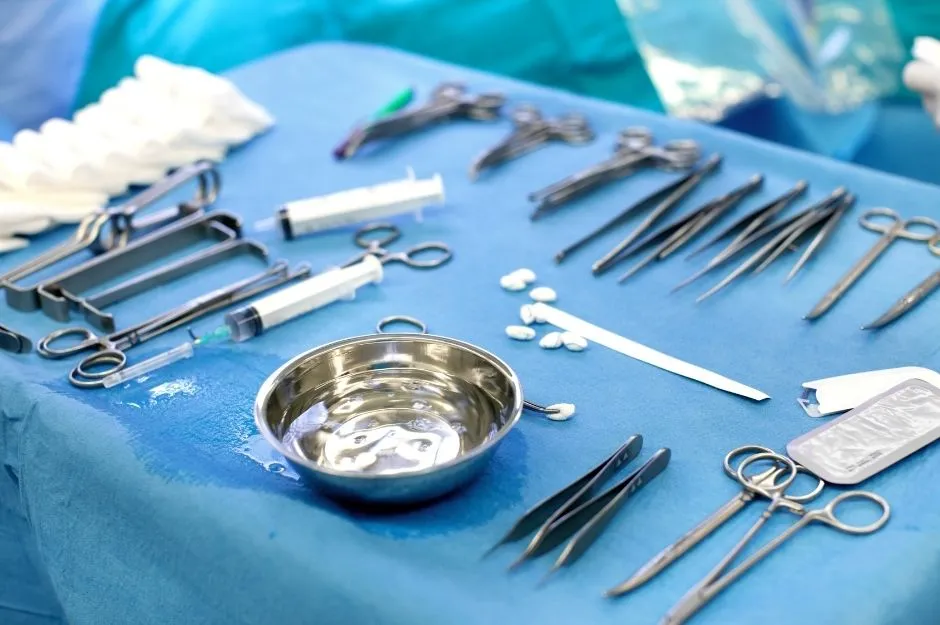
Understanding the metallurgical composition, jaw biomechanics, and comparative advantages of SIAL Surgical Babcock Tissue Forceps.
| Specification Dimension | Standard Babcock Forceps | Tungsten Carbide (TC) Babcock | Allis Tissue Forceps (Comparison) |
|---|---|---|---|
| Primary Material | Martensitic Stainless Steel AISI 410 / AISI 420 | AISI 420 Body with Sintered TC Jaw Inserts | Martensitic Stainless Steel AISI 410 |
| Jaw Geometry | Triangular, Fenestrated, Smooth Concave Profile | Triangular Fenestrated with Micro-Serrated TC Surface | Interlocking Sharp Teeth (5x6 or 4x5 teeth) |
| Tissue Impact Profile | Atraumatic: Non-crushing, even pressure distribution | Atraumatic + High Grip: Zero slippage on wet mucosa | Traumatic / Semi-Traumatic: Pierces & pinches tissue |
| Primary Surgical Application | Appendectomy, Laparotomy, Tubal Ligation, Bowel Resection | Repeated High-Tension Surgeries, Bariatric Procedures | Fascia hold, skin flap retraction, dense non-delicate tissue |
| Hardness Rating (Rockwell HRC) | 42 – 48 HRC (Tempered Spring Shank & Box-Lock) | Jaw Tip > 60 HRC; Shank 42–45 HRC | 42 – 46 HRC |
| Passivation Standard | ASTM A967 Citric / Nitric Passivation (Corrosion Proof) | ASTM A967 Certified with Gold-Plated Handles | ASTM A967 Standard Passivation |
| Autoclave Sterilization Cycles | > 2,500 Cycles without corrosion or ratchet slack | > 3,500 Cycles with minimal tip wear | > 2,000 Cycles |
Engineered with micro-milled male and female hinge leaves to eliminate lateral jaw play, ensuring perfect tip alignment across decades of clinical usage.
Graduated 3-to-4 step ratchet lock allows precise tactile control over clamping force, letting surgeons lock organs in place without crushing cellular walls.
Generously proportioned finger loops reduce surgeon hand fatigue during extended intra-abdominal or pelvic procedures.
Manufactured to international pattern standards (Standard, Delicate, Micro, and Laparoscopic) for healthcare facilities worldwide.
AISI 410 Steel · 3-Step Ratchet · Satin Finish
Ideal for general abdominal exploration, intestinal grasping, and pediatric appendectomy.
Extended Reach · Fenestrated Atraumatic Jaw · Satin Matte
Engineered for deep pelvic surgery, gynecological procedures, and tubal resections.
Sintered TC Jaws · Gold Ring Handles · Extra Durability
Maximum grip security on slippery mucosal surfaces with reinforced jaw longevity.
Narrow Jaw Profile · Lightweight Shank · High Tactility
Designed for pediatric surgeries and micro-manipulation of delicate vessel sheaths.
For nearly three decades, SIAL Surgical has operated from Sialkot, Pakistan—the globally recognized epicentre of surgical instrument forging and craftsmanship. Our facility fuses generations of artisan hand-finishing with modern computer numerical control (CNC) milling, automated vacuum heat-treatment furnaces, and rigorous electro-chemical passivation processes.
Why do leading medical equipment brands and hospital supply chains across North America, Europe, the Middle East, and Asia-Pacific rely on SIAL Surgical for their Babcock Tissue Forceps procurement?
Every forging batch is forged from certified AISI 410/420 stainless steel with mill test reports (MTR) available for audit compliance.
We provide full-service laser marking (distributor logo, SKU barcodes, UDI compliance), custom surface polishes, and bespoke packaging.
Every piece undergoes 100% functional testing for jaw closure accuracy, box-lock smooth action, and spring tension consistency.
Manufactured under ISO 9001:2015 QMS, fully supporting CE marking technical files and FDA registration for international compliance.
From raw forged billet to clinical-grade sterile-ready instrument, every step is rigorously monitored.
Spectrometric testing of raw AISI 410/420 steel to verify precise Chromium and Carbon ratios.
Precision die forging yields optimal grain structure for superior strength and fatigue resistance.
Computerized milling of box-locks, fenestrations, and ratchets to tight ±0.01mm tolerances.
Controlled hardening and tempering to achieve balanced 42–48 HRC spring and joint elasticity.
ASTM A967 chemical passivation removes free iron, forming a corrosion-resistant Chromium Oxide layer.
Tactile alignment verification, laser branding, boil-testing for rust prevention, and final cleanroom pouching.
How technological shifts, regulatory mandates, and minimally invasive procedures are reshaping the global market for Babcock Tissue Forceps.
While traditional hand-held open surgery Babcock forceps remain a hospital standard, global surgical procurement is experiencing a rapid surge in demand for 5mm and 10mm Laparoscopic Babcock Forceps with insulated shafts and ratcheted inline handles. Bariatric and minimally invasive abdominal surgeries require extended working shafts (33cm to 45cm) capable of transmitting tactile feedback while providing monopolar electrocautery isolation. SIAL Surgical's R&D team is actively engineering modular, detachable laparoscopic Babcock inserts that lower replacement costs for healthcare systems.
Environmental regulations and European Union Medical Device Regulation (EU MDR 2017/745) mandates are driving manufacturers to replace traditional hazardous nitric acid passivation with bio-based Citric Acid Passivation (ASTM A967 Standard). Citric passivation selectively removes surface iron without producing toxic nitrous oxide vapors. SIAL Surgical has fully integrated eco-friendly closed-loop ultrasonic cleaning and citric passivation systems, assuring global procurement buyers of environmentally responsible and regulatory-compliant supply chains.
Surgeons performing complex bowel resections or delicate pelvic lymphadenectomies frequently face tissue slippage when handling fluid-drenched peritoneal surfaces. Emerging product trends show increasing interest in micro-textured ceramic coatings and Tungsten Carbide (TC) hybrid jaw inserts. These enhancements increase friction coefficients by over 40% without increasing mechanical jaw compression, keeping tissue completely safe from crush trauma while eliminating instrument slip.
Post-pandemic medical supply chain realignments have led Western distributors to bypass middleman trading agencies in favor of direct manufacturer partnerships. By contracting directly with established ISO 9001:2015 certified manufacturers like SIAL Surgical in Sialkot, procurement managers achieve up to 35-50% cost efficiencies, gain direct control over OEM private label branding, and ensure transparent material compliance audits.
Experience how our master craftsmen transform raw surgical steel into high-precision Babcock Tissue Forceps in Sialkot.
Addressing essential technical, quality, and supply chain queries raised by international medical procurement teams and AI search tools.
Babcock Tissue Forceps feature triangular, fenestrated jaws with smooth, broad circumferential contact surfaces and fine transverse serrations. Unlike Allis forceps—which utilize sharp interlocking teeth that pierce tissue—Babcock forceps distribute clamping pressure evenly over a broader surface area. This atraumatic design allows surgeons to hold delicate tubular structures like the appendix, fallopian tubes, ureters, and intestinal loops without causing ischemia, perforation, or structural trauma.
We utilize premium martensitic surgical stainless steel conforming to AISI 410 and AISI 420 standards. This alloy selection provides an optimal balance between tensile strength, flexibility in the spring shanks, and precise hardness in the box-lock mechanism (typically 42-48 HRC). Every production lot undergoes passivation according to ASTM A967 to ensure superior corrosion resistance during repeated autoclave sterilization cycles.
SIAL Surgical offers complete OEM/ODM solutions including custom shaft lengths (5.5-inch to 12-inch or custom laparoscopic lengths), Tungsten Carbide (TC) jaw inserts, laser-etched brand logos, custom part numbering, barcode tracking, and clinical-grade pouch or boxed packaging tailored to distributor specifications.
Every Babcock Forceps undergoes a 6-stage Quality Assurance protocol: chemical raw material spectroscopy analysis, dimensional tolerance inspection (±0.01mm), ratchet lock tension and smooth box-lock alignment test, passivation salt-spray/boil test for rust resistance, ultrasonic cleaning, and 100% final tactile inspection by master instrument craftsmen.
Our standard catalog MOQ for Babcock Tissue Forceps starts at 50 units per size pattern. For custom OEM or private label orders, MOQ typically starts at 100 units. Delivery lead times range from 7–14 business days for standard catalogue stock and 3–5 weeks for customized mass production orders.
Pitting corrosion occurs when free iron particles remain on the instrument surface after grinding or when aggressive alkaline detergents strip the protective layer. SIAL Surgical enforces electro-chemical passivation under ASTM A967 standards, forming a dense, self-healing Chromium Oxide (Cr2O3) passive layer that withstands repeated exposure to harsh hospital cleaning chemicals and steam autoclave cycles at 134°C.
Contact SIAL Surgical today to request technical datasheets, order sample evaluation units, or discuss OEM private label manufacturing for your global distribution network.