Choosing the right Metzenbaum Surgical Scissors begins with understanding tissue, access, and the surgeon’s hand. These instruments are designed for delicate dissection, not heavy cutting.
Myron Metzenbaum, the surgeon associated with their development, is often credited with the principle, “The instrument should follow the hand, not fight it.” The wording appears differently across historical references, but the idea remains useful. A well-balanced instrument should feel controlled between the thumb and ring finger. It should open smoothly and close without forcing the wrist.
The main types include straight, curved, blunt-tip, sharp-tip, and tungsten carbide Metzenbaum Surgical Scissors. Straight models provide a clear line for superficial tissue work. Curved patterns improve visibility around vessels and deeper anatomical planes. Blunt-tip versions may reduce accidental tissue catching during spreading. Sharp-tip designs offer a more precise entry point. Tungsten carbide inserts can preserve cutting performance during repeated clinical use.
Size also changes performance. A 5½-inch pair offers close control in confined areas. Longer versions reach deeper fields but may feel less responsive. That trade-off matters.
The categories are not perfectly clean. Some designs overlap in length, tip shape, and intended use. Product labels can also be inconsistent between manufacturers. Surgeons should inspect hinge alignment, blade sharpness, jaw symmetry, and sterilization compatibility before relying on any pair. A polished appearance proves little. The scissors must perform under real pressure, beside delicate tissue, with predictable movement.
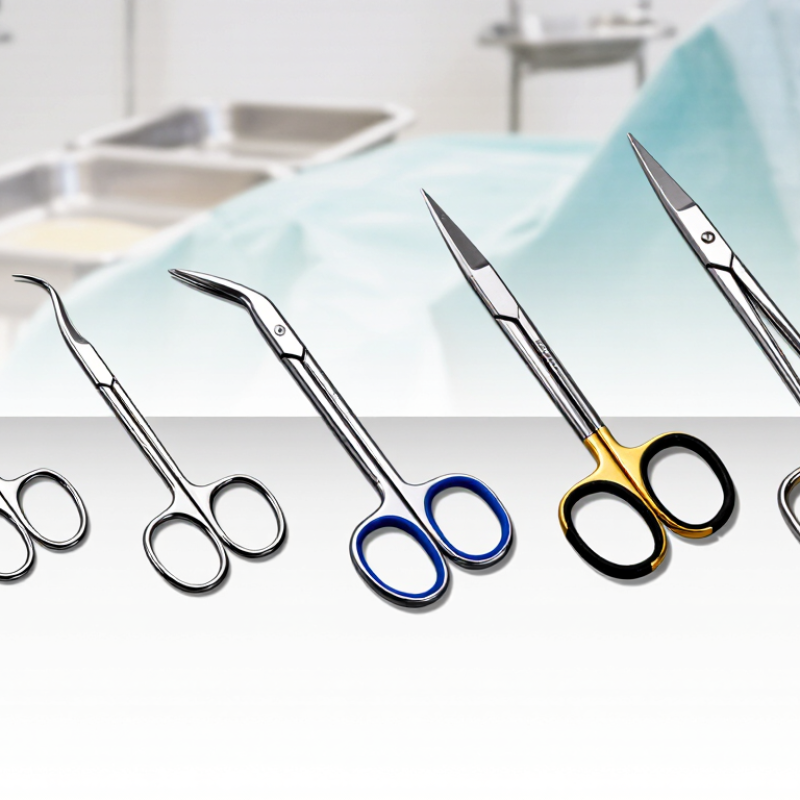
Metzenbaum scissors are delicate instruments designed for cutting and bluntly dissecting soft tissue. Their narrow blades and long shanks help surgeons work through small openings. The finger rings support controlled movement, while the relatively short cutting edges reduce accidental tissue damage. Many models have rounded tips, which can separate tissue planes with less risk than sharp-pointed scissors.
Common designs include straight and curved Metzenbaum scissors. Straight patterns offer a clear cutting path and are useful near the surface. Curved patterns improve visibility in deeper areas, especially when the hand would otherwise block the field. Different lengths also exist. Longer versions reach deeper spaces, but they may feel less stable during fine dissection. The instrument should not be used for cutting sutures or thick material. That can dull the edges quickly.
Tips: Choose the smallest suitable size. Check blade alignment, smooth movement, and secure finger rings before use. Curved scissors should follow the tissue plane, not force it. Handle them gently. I have seen minor alignment problems become obvious during delicate work. Cleaning and sterilization must follow the facility’s validated instructions. Even a well-designed scissor can perform poorly after rough handling, so inspection should remain part of every setup.
Metzenbaum scissors are delicate surgical instruments designed primarily for cutting and dissecting soft tissue. The most common configurations are straight and curved patterns, with overall lengths commonly available around 14, 18, 23, and 26 cm.
How to read the chart: Shorter straight scissors are useful for controlled dissection in smaller or more accessible areas, while longer curved scissors provide improved reach and visibility during deeper tissue dissection. Actual dimensions and jaw configurations may vary by instrument specification.
Metzenbaum scissors are designed for delicate tissue dissection, not cutting sutures or heavy materials. Their slender blades offer controlled movement around fragile structures. The main types differ by blade curve, tip shape, and overall length.
Curved, blunt-tip Metzenbaum scissors are widely used for separating tissue planes. Their rounded ends help reduce accidental catching during controlled dissection. Straight Metzenbaum scissors provide a clearer cutting path in exposed areas. They can feel easier to guide when the tissue lies directly in front of the operator.
Sharp-blunt models combine one pointed tip with one rounded tip. This design can enter a tissue plane while limiting damage on the opposite side. Curved, sharp-tip versions offer more precise access in narrow spaces. They demand careful handling, especially near vessels and nerves.
Micro Metzenbaum scissors have finer blades for small, detailed work. Longer patterns may improve reach in deeper surgical fields. However, extra length can reduce fingertip control. That trade-off is easy to overlook.
In practical instrument selection, the correct type depends on tissue thickness, visibility, and dissection depth. A common mistake is treating every curved pair as interchangeable. It is not. Scissors should open smoothly, meet evenly, and remain free from blade damage. Clinicians should also follow facility protocols for inspection, cleaning, sterilization, and safe use.
Metzenbaum surgical scissors are designed for delicate tissue dissection, but their performance depends heavily on blade shape, length, and tip design. Straight blades suit superficial work and controlled cutting near the operative field. Curved blades improve visibility in deeper tissue planes, where the hand can otherwise block the surgeon’s view. A practical mistake is choosing curvature by habit rather than depth.
Length also changes control. Common sizes range from about 5.5 to 10.5 inches. Short scissors usually provide better tactile feedback during fine dissection. Longer models can reach deeper cavities, but they may feel less precise in narrow spaces. The Lancet Commission estimated roughly 313 million surgical procedures occur worldwide each year, highlighting the importance of consistent instrument selection and training. That figure does not prove one length is superior. It shows why standardized preferences matter.
Tip design deserves close inspection. Fine, sharp tips separate fragile tissue with less spreading, while blunt tips reduce accidental penetration during broader dissection. Some instruments combine one sharp tip with one blunt tip, offering controlled access around delicate structures. The distinction is not absolute. Tissue type, exposure, and surgeon technique still govern the choice. AORN perioperative guidance emphasizes inspecting instruments for alignment, smooth movement, and damage before use. Hold the scissors closed, check the tips under good light, and test the hinge gently. Small defects can change cutting pressure. That detail is easy to overlook.
| Type | Blade Shape | Typical Overall Length | Typical Blade Length | Tip Design | Common Application | Main Characteristics |
|---|---|---|---|---|---|---|
| Standard Curved | Gently curved blades with a slim, elongated profile | 14–23 cm | Approximately 3–7 cm | Usually blunt/blunt or sharp/blunt | General soft-tissue dissection and tissue separation | The curved profile improves visibility and allows dissection along natural tissue planes. |
| Standard Straight | Straight, narrow blades aligned with the instrument shaft | 14–23 cm | Approximately 3–7 cm | Commonly blunt/blunt or sharp/blunt | Superficial dissection, trimming, and procedures requiring a direct cutting path | Provides a direct line of sight and predictable blade movement in accessible areas. |
| Long Curved | Curved blades mounted on an extended shaft | 20–23 cm | Approximately 5–7 cm | Typically blunt/blunt or sharp/blunt | Deep-cavity and narrow-field soft-tissue dissection | The longer reach helps access deeper structures while the curved blades reduce obstruction of the operative field. |
| Short Curved | Compact curved blades with a shorter working length | 14–16 cm | Approximately 3–4 cm | Usually blunt/blunt | Fine dissection in small or superficial operative fields | Offers improved control and reduced hand fatigue when extensive reach is unnecessary. |
| Blunt/Blunt Tip | Available with straight or curved blades | 14–23 cm | Approximately 3–7 cm | Both blade tips are rounded | Blunt dissection and separation of delicate soft tissue | Reduces the risk of inadvertent puncture compared with pointed tips, but is less suitable for precise piercing. |
| Sharp/Blunt Tip | Usually straight or curved, with one pointed tip and one rounded tip | 14–23 cm | Approximately 3–7 cm | One sharp tip and one blunt tip | Combined cutting and dissecting tasks requiring selective tip access | Balances tissue protection with the ability to enter or separate a tissue plane accurately. |
| Sharp/Sharp Tip | Straight or curved blades terminating in two pointed tips | 14–20 cm | Approximately 3–6 cm | Both blade tips are pointed | Precise cutting where tip penetration and fine control are required | Provides accurate entry and cutting but requires greater care around fragile structures. |
| Delicate Fine-Pattern | Narrow, lightweight straight or gently curved blades | 14–18 cm | Approximately 3–5 cm | Most often blunt/blunt or sharp/blunt | Fine dissection in superficial, confined, or anatomically delicate areas | The reduced blade mass supports controlled movements but is not intended for heavy tissue or dense material. |
Note: Dimensions are typical catalog ranges for Metzenbaum-pattern scissors; exact measurements vary by manufacturer, instrument pattern, and intended procedure.
Blade length matters more than many new users expect. A shorter instrument often feels steadier near the skin or in a narrow field. Longer shafts can reach deeper cavities, but they may reduce tactile feedback.
Blunt tips can help limit accidental puncture around fragile structures. Sharp tips provide more precise entry when separating fine tissue layers. The choice should match the procedure, surgeon preference, and local instrument policy.
I check the hinge before use. It should open smoothly without lateral wobble. The blades must meet evenly, because poor alignment can crush tissue instead of separating it. A pair may look acceptable yet feel awkward after repeated sterilization. That detail deserves attention. Handles should support a controlled grip without forcing the thumb or ring finger. Serrated versions may improve grip on selected materials, but they are not automatically suitable for delicate tissue. I have also seen users choose overly long scissors for convenience, then lose precision in a confined field. Practical selection is partly technical and partly learned through supervised handling. When uncertainty remains, consult the operating surgeon or an experienced sterile-processing professional.
Metzenbaum scissors are designed for delicate tissue, not wire, sutures, or heavy materials. Curved models improve visibility around tissue planes, while straight models support precise cutting in open fields. Blunt tips can reduce accidental punctures during dissection. Sharp tips offer cleaner entry but demand greater control. The choice matters during cleaning because fine blades and narrow hinges can retain soil.
Care begins at the point of use. Wipe visible blood with approved water-based materials, then keep the scissors moist until decontamination. Do not leave them closed. Open the jaws fully, separate removable parts, and inspect the hinge under bright light. AAMI ST79 recommends mechanical, chemical, and biological monitoring for steam sterilization processes. Follow the instrument’s validated instructions, because temperature, exposure time, packaging, and load arrangement can differ.
The CDC classifies instruments entering sterile tissue as critical devices, requiring sterilization before reuse. WHO reports that surgical-site infections affect about 11% of surgical patients in low- and middle-income countries. That figure makes small handling errors less acceptable. Steam sterilization is commonly preferred for heat-stable instruments, but overloaded trays can block air removal and steam contact. Let scissors cool before handling, and never force a stiff hinge. It is tempting to lubricate quickly, yet the wrong product may damage surfaces or interfere with sterilization. A rushed inspection can still happen. That is the part worth questioning. Reprocess any instrument with residue, corrosion, misalignment, or unexpected resistance.
They are designed for delicate soft-tissue cutting and blunt dissection. Their narrow blades support controlled movement. They are not intended for thick materials.
Straight scissors provide a clear path near exposed tissue. Curved scissors improve visibility in deeper areas. The curve should follow the tissue plane gently.
Rounded tips can separate tissue planes with less catching. They may reduce accidental punctures during careful dissection. They still require controlled handling.
Sharp-blunt designs can enter a tissue plane while protecting the opposite side. Sharp tips may provide cleaner entry in narrow spaces. Use extra caution near vessels and nerves.
Choose the smallest suitable size for the task. Longer scissors reach deeper spaces but may reduce fingertip stability. More reach is not always better.
Check blade alignment, smooth opening, and secure finger rings. Inspect the hinge under bright light. A tiny alignment problem can become obvious during fine work.
No. Such materials can quickly dull delicate edges. Use an instrument designed for heavier cutting instead. The wrong tool causes avoidable damage.
Remove visible soil with approved water-based materials. Keep the instrument moist until decontamination. Open the jaws fully during cleaning. Follow validated facility instructions for sterilization.
Do not force it or apply an unapproved lubricant. Reprocess the instrument if residue, corrosion, misalignment, or resistance appears. A rushed inspection still happens. That deserves questioning.
Metzenbaum Surgical Scissors are delicate instruments designed for cutting and dissecting soft tissue with precision while minimizing unnecessary trauma. Their lightweight construction, slender profile, and finely aligned blades make them useful in procedures that require controlled movement in confined areas. Common types include straight and curved versions, with variations in overall length, blade width, and tip configuration. Blades may be sharp or partly blunt, and tips can be pointed, rounded, or designed for safer tissue separation, allowing surgeons to match the instrument to specific tasks.
Selecting the right scissors depends on the tissue, depth, visibility, and level of control required. Shorter scissors support precise work near the surface, while longer models can reach deeper sites. Proper care is equally important: instruments should be inspected, cleaned promptly, sterilized according to approved protocols, and stored to protect their edges and alignment. Safe handling includes using them only for suitable tissue, avoiding excessive force, and checking for damage before and after each procedure.